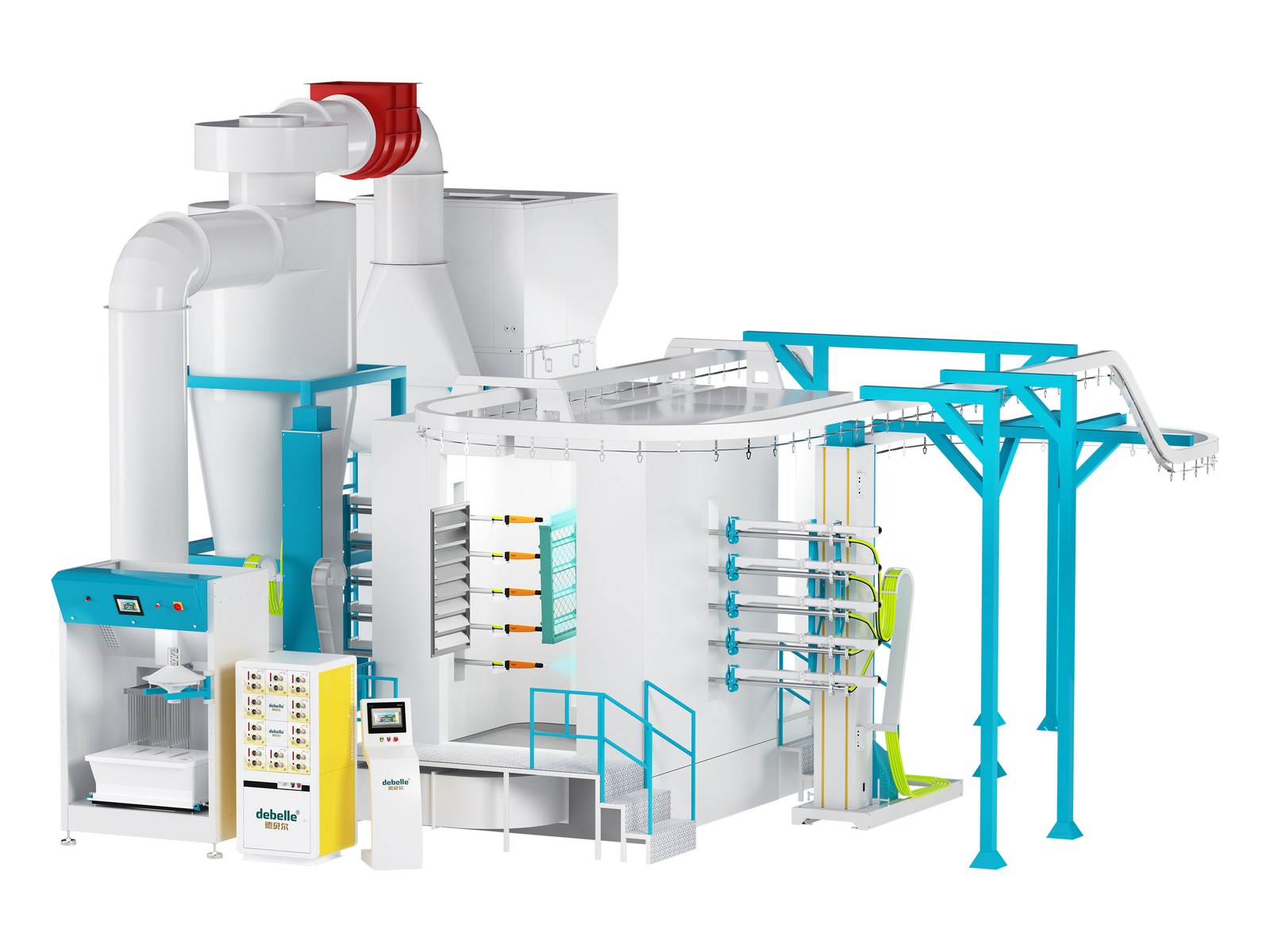
A powder coating machine on a quotation is not one kind of equipment.
Powder travels from the hopper to the part along one of four routes: carried by a human hand, by a gun fixed in a cabinet, by a gun riding a reciprocator, or by an arm that replays a recorded path. Who carries the gun decides what work the machine can take, and what it costs you to change part or colour.
1. One line splits the four: who carries the gun to the part
All four share the same physics: powder is fed by a pump, charged inside the gun, atomised, attracted to a grounded part, then cured in the oven. The only difference is how the gun gets to the part.
| Machine type |
Who carries the gun |
How parts move |
Work it can take |
Cost of a part or colour change |
| Manual single unit |
A person |
Loaded and unloaded by hand |
Small parts, many colours, touch-up, sampling |
Put the gun down and switch, almost no line stop |
| Fixed automatic gun |
Gun fixed in a cabinet |
Conveyor carries parts past the gun |
Regular flat panels, mesh, tube |
Reset gun position, purge for colour, a stretch of downtime |
| Automatic gun on a reciprocator |
Lift carries the gun up and down |
Conveyor runs continuously |
Tall part faces: profiles, doors, posts |
Change stroke and speed, downtime |
| Teach-free robot |
Arm replays a recorded path |
Conveyor or indexing table |
Odd shapes, complex paths, repeat batches |
Re-teach, once per batch |
Only one column splits them: who carries the gun. With a human carrier, judgement stays in the hand. With a machine carrier, judgement is written into stroke, speed, gun distance and programme. So “is this machine any good” really asks “does this way of carrying the gun suit this job”.
2. Manual single unit: judgement stays in the hand
A manual gun competes on switching speed, not on output. Put the gun down and you have changed part, colour and angle; in deep recesses and internal corners you can change angle and distance as you go. Two things to look at when choosing:
- Voltage tier: on a line dominated by flat panels, an 80 kV unit is enough — for example the E7 manual electrostatic powder coating gun; for metal powders, recessed parts and re-coats, the 100 kV tier is more comfortable. Guns with automatic tracking adjust current and voltage to the distance between the electrode and the part.
- Whether parameters need storing: with many part types, choose a model that stores programmes. Some hold 20 main programmes and over 500 sub-programmes, so flat parts become P01, recessed parts P02 and re-coats P03, recalled by number when the shift changes.
Keep the gun tip 200 to 300 mm from the part: closer and the film builds up and orange peel appears, further away the powder spreads in flight and coverage thins.
A manual stage has two output ceilings: the operator’s stamina and the operator’s consistency. Once volume goes up and the colour count stays low, the manual stage becomes the bottleneck.
3. Fixed automatic gun: the gun stays, the part moves
The gun is mounted in a cabinet, set once and left alone, and a conveyor carries parts past it at a fixed speed. There is no reciprocating mechanism, so there are fewer maintenance points. It suits work that is regular in shape, sprayed on one face, in one colour and in volume: guardrail mesh, steel tube, flat doors. Change the part outline and the gun position has to be reset; add colours and purge downtime eats the output.
Two things to confirm before you install one:
- Rigidity of the gun mount. A mount that flexes produces a banded finish, so use a steel tube with enough stiffness. A machine in the field that started to shake and lose accuracy after a while was cured by going back to a steel tube.
- Inspection interval for the powder hose. An automatic line runs continuously, so the inner powder hose wears faster than on a manual gun. A monthly check is enough on a manual gun; on an automatic gun check by shift, and replace when the wall thins or a longitudinal crack or split appears, since powder leaks through the crack.
4. Automatic gun on a reciprocator: making the gun travel
A fixed gun cannot cover a tall part: one stationary gun holds one height band only. Mounted on a lift, the gun travels up and down at a set stroke and speed and covers the whole face height. It is normally an automatic gun, such as the V12 automatic powder coating gun.
| Setting |
What you set |
How to confirm on site |
| Stroke |
Cover the part height with overrun at both ends |
Check the coating at the top edge, bottom edge and middle |
| Speed |
Works with conveyor speed, decides passes per position |
Check film thickness along one horizontal line |
| Gun distance |
Again 200 to 300 mm |
Measure gun tip to part with a caliper, not by eye |
A common trap: orange peel at the top and bottom edges while the middle is fine. Suspect the stop positions at the ends of the stroke first — set wrongly, the number of passes at the reversal differs from the middle, and one square tube at each end is a practical fix. Gun count matters too: crowding too many guns at one height forces each gun’s powder output down, and pressing it too far spoils atomisation.
5. Teach-free robot: recording what the operator does
It does not rely on stroke coverage but on a recorded path: the operator sprays manually once, the machine records the motion and replays it afterwards. That suits work that is complex in shape and irregular in path but repeated within the same batch — odd-shaped parts, housings with recesses or ribs, curved panels. Three questions before you install one:
- How many parts in a batch: recording and replaying is per batch, so a batch that is too small never amortises the setup time.
- How often the part changes: every change needs re-teaching, and on a high-mix line setup time becomes the main cost.
- How parts are conveyed: the robot only sprays, while loading, indexing and curing still need a conveyor or a table.
One point is often missed: the robot replays a path, not the judgement that a pass looked wrong. Voltage, powder output and atomisation still need a card of standard values on the shop floor.
What to check when something goes wrong
| Symptom |
Likely cause |
How to confirm |
| Orange peel at top and bottom edges of an automatic section, middle fine |
Reciprocator stop positions not set |
Compare edges with the middle; trial a square tube at each end |
| Automatic gun shakes, banded finish |
Gun mount tube lacks rigidity |
Push the mount and look for movement; check it is a steel tube |
| Output drops and powder leaks at the head after a few shifts |
Inner powder hose worn to a crack or split |
Open it up by shift and check wall thickness and cracks |
| Film thickness drifts after a shift change on a manual stage |
Parameters were never written down |
Write voltage, powder output and gun distance on a card, compare with the previous shift |
Self-check list
If you are not sure which family fits, send the part photo, dimensions, daily output and number of colours and we will work through this logic for a recommendation; where it helps, send a sample part for a trial spray and let measured data set the configuration. Contact us