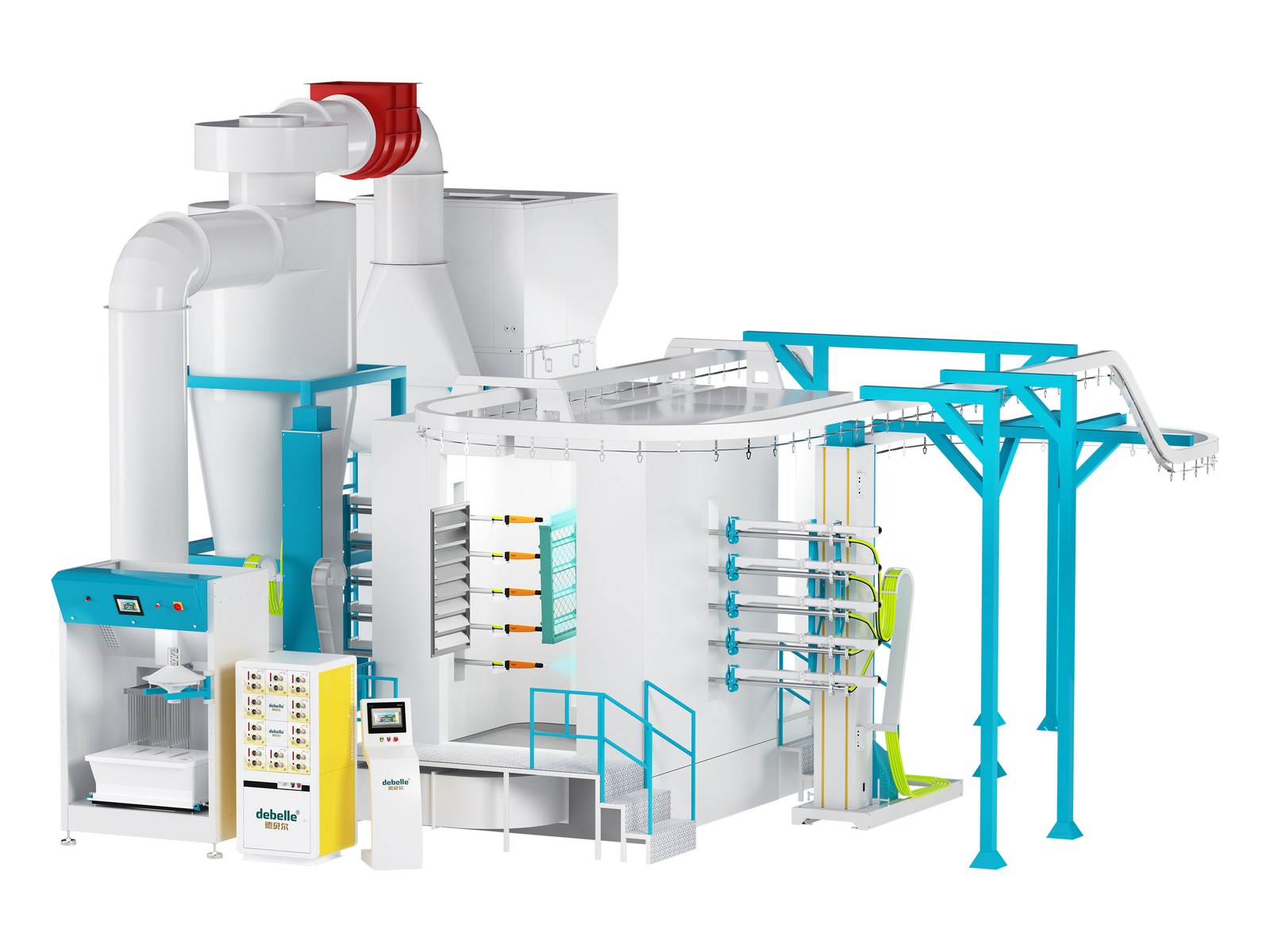
Choosing a powder coating machine is not a spec-sheet comparison. The same unit behaves very differently in two workshops: a 0–500 g/min single machine is fine for small flat parts and clearly short of the job on a two-metre vertical line. Measure four site conditions first, then work through seven decisions — powder output, adjustment method, power, air use, automation level, colour-change method and cabinet capability.
How to Size a Powder Coating Machine: Measure Four Site Conditions First
| Site item |
How to measure it |
Decisions it settles |
| Part size and hanging density |
Measure the long edge and parts per hanger, then convert to hanging points per square metre |
Gun count, spray pattern, extension bar and powder hose length |
| Daily output and takt |
Hangers per hour × effective spraying time |
Powder output tier, whether automation is needed |
| Colours and change frequency |
Count colour changes per day and downtime per change |
Colour-change method, whether a powder feed centre is needed |
| Air and power supply |
Measure pressure at the point of use and network headroom, confirm 220 V capacity |
Power, air consumption, whether a buffer tank is needed |
Once these four numbers are on paper, the trade-offs among the seven decisions mostly fall into place.
Decisions 1–2: Powder Output and How It Is Adjusted
Output follows the part and the takt, not the biggest number on the sheet. A practical route is to work out powder per hanger, multiply by the hanging takt, and read back how many grams per minute are actually needed.
| Output tier |
Adjustment method |
Typical fit |
| 0–450 g/min |
Electronic precision flow valve |
Multiple colours, small batches, repeatable settings |
| 0–500 g/min |
Pressure regulator valve |
Flat parts, single colour, continuous running |
The adjustment method affects daily work more than the number does. A regulator valve sets powder flow by air pressure — simple, and well suited to one colour running continuously. An electronic precision flow valve stores settings you can recall, so a shift change does not mean hunting for the feel again. The E7 manual powder coating gun uses the regulator-valve route; models a tier up generally use the electronic valve.
Decisions 3–4: Power, Air Pressure and Air Use
Power is often overrated. A manual single machine typically draws around 35–50 W at the main unit; the real load sits with the compressor and the curing oven. Read power together with input voltage, input pressure and air consumption.
| Parameter |
Typical range |
Note |
| Input voltage |
AC 220 V, 50 Hz |
Check socket capacity and cable gauge |
| Main unit power |
About 35–50 W |
Electronic flow-valve models mostly sit at 35 W |
| Input pressure |
About 6 kg, not below 0.6 MPa |
Too low and powder output drops |
| Air consumption |
≤0.3 m³/min per gun |
Sum across guns, then keep headroom |
| Operating temperature |
-20 °C to 50 °C |
Hot, humid sites need a separate allowance |
An unstable supply is the usual cause of powder output that drifts up and down. Check the four links in order — compressor capacity, receiver tank volume, number of take-off points and leaks in the pipework — and add a buffer tank near the gun if the network is short of headroom.
Decisions 5–6: Automation Level and Colour Change
| Automation tier |
Composition |
Suitable work |
| Manual single machine |
Main unit, powder hopper, manual gun |
Odd shapes, small batches, many colours |
| Automatic single gun |
Main unit, automatic gun, control cabinet |
One part running continuously at volume |
| Automatic line with linked control |
Multiple main units, powder feed centre, recovery |
High volume, frequent colour changes |
Automatic models have one easily missed benefit: spraying starts when a part is on the conveyor and stops on an empty hook, so powder is not wasted. To decide whether automation pays, look at two numbers — whether hangers per shift are steady, and whether spraying time per part is long enough. Where the count swings and cycle time is short, an automatic gun is harder to justify.
Fast colour change is about recovery and cleaning, not the gun. A model such as the V12 automatic powder coating gun supports one-button cleaning, which clears the pump, hose and electrode needle and then returns to the main program. Add a powder feed centre and the powder box sits directly on the fluidising hopper, with automatic cleaning of the suction tube, pump, hose and gun interior and recovered powder returned to the box. That combination is what compresses changeover.
Decision 7: Control Cabinet and Multi-Gun Control
The cabinet decides how usable and how manageable the machine is. Three things to check: can all guns be set for powder, atomising air and static from one screen; can settings be stored as recipes and recalled at shift change; and can the line keep running when something fails. A common arrangement lets every main unit work independently and also control the others, so a failed unit can be taken over by its neighbours instead of stopping the whole line.
Check the footprint early: a standard cabinet is about 600 × 697 × 1931 mm and a compact one about 790 × 600 × 1800 mm — leave room for the door swing and cable routing. Cabinets that will not fit through the workshop door are a yearly occurrence.
| Symptom |
Likely cause |
How to confirm |
| Powder output drifts |
Unstable supply pressure |
Fit a gauge at the gun and watch it during spraying |
| Speckles on the first parts after a change |
Residue in the powder path or recovery |
Run a cleaning cycle alone and see whether powder still comes out |
| Colour shift between shifts |
Settings held by feel, not recorded |
Compare the voltage, powder output and gun distance logged by both shifts |
| Thin coverage in recesses or at distance |
Gun too far, or voltage too low |
Check the voltage band for the part type and retest at a shorter distance |
Voltage can start from the part type: 70–90 kV for flat panels, 60–80 kV for recessed parts and 20–40 kV for touch-up. Main units normally adjust from 0–100 kV with 0–100 μA of current.
Self-Check List
Send us your part photos, dimensions and daily output and we will put a configuration against these seven decisions, with a sample spray first where it helps — the final settings should come from measured results. You can also reach us through the contact page.