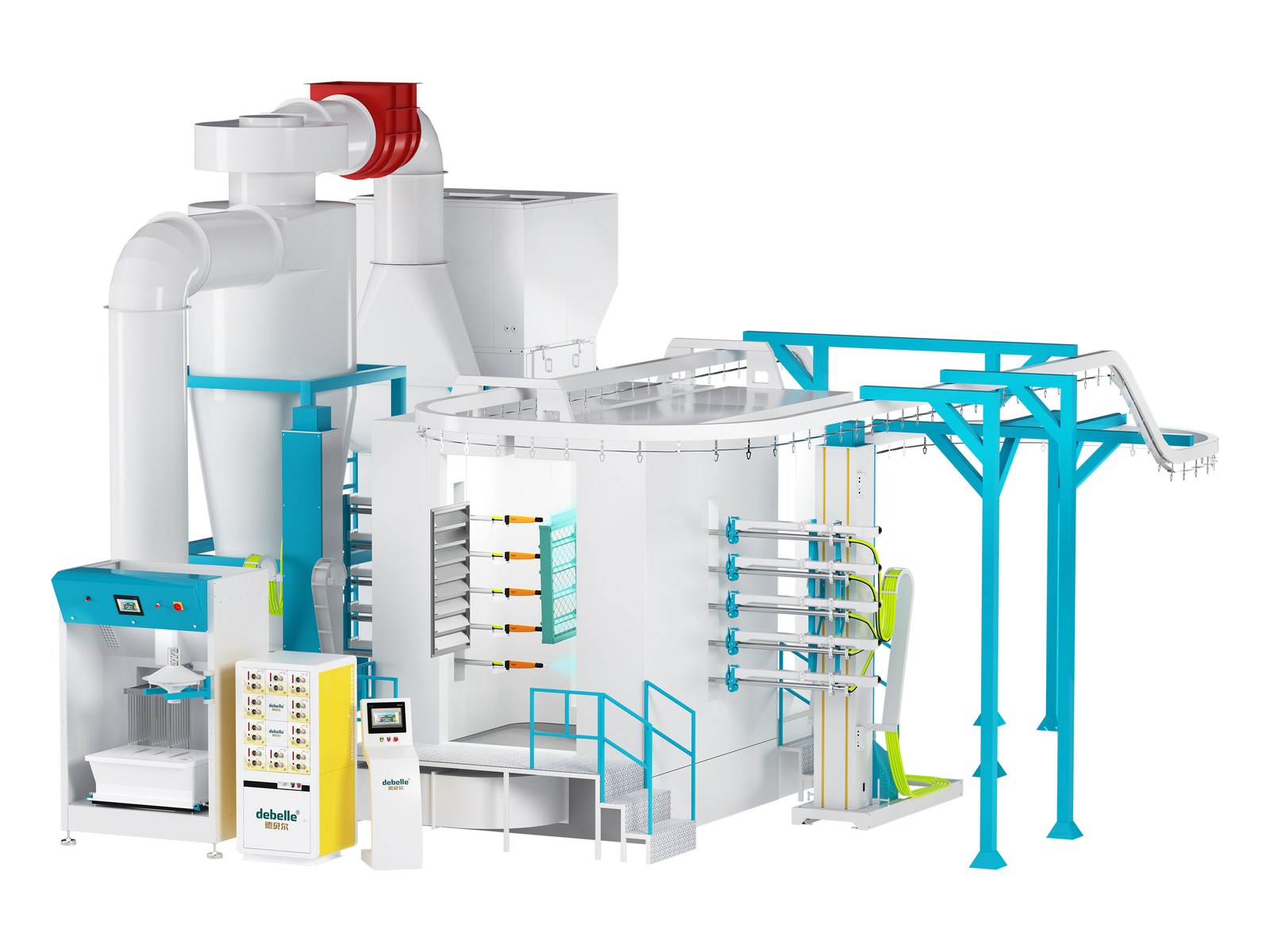
Ask two suppliers for a powder coating machine price and you can get two very different documents: one is a gun and a hopper, the other a whole line with conveying and curing. The gap is not haggling room, it is modules — every step up buys a complete set of system parts.
Four Steps: Each One Buys a Whole Set of System Parts
| Step |
Modules added over the step below |
Where the money sits |
When this step is the right one |
| Manual single unit |
Main unit, hopper, one manual gun and its full accessory set |
The main unit and the gun |
Odd shapes, small batches, many colours, parts you can hold by hand |
| Multi-gun manual / small booth |
Booth enclosure, cartridge recovery, spare guns |
Enclosure and recovery |
Several colour changes a day, powder has to be contained and reclaimed |
| Semi-automatic line |
Automatic guns, reciprocator or fixed positions, control cabinet |
The cabinet and the reciprocator |
One or few colours, steady hanging, long enough spray time per part |
| Full automatic line |
Powder feed centre, two-stage recovery, linked main units, continuous conveyor and curing oven |
Feed centre, recovery, conveying and curing |
High volume, long parts, downtime costed by the minute |
Look at that “full accessory set” in the first row. A typical single-unit list already carries the main unit, a static gun, powder hose, hopper, locking collars, three sizes of nozzle in threes, a flat nozzle with electrode, extension bar, powder pump and suction rod, three venturi tubes, earth cable and air hose. On the same main unit, how complete the accessory set is can move the price by a full step on its own.
Why a Powder Coating Machine Price Spreads Within One Tier
The step decides the form; inside a step, the gap comes from three places.
| Price item |
Lean build |
Fuller build |
Worth adding when |
| Main unit and gun type |
Manual gun, regulator valve for powder flow |
Automatic gun, electronic precision flow valve |
Settings must be stored and recalled, not re-found at every shift change |
| Accessory set |
One set of nozzles and venturi tubes |
All three nozzle sizes, extension bar sized to the longest part |
Part types change often, or you spray deep recesses and long parts |
| Hose length |
Straight run at the standard length |
Cut to the actual gun position, with curved routing |
Gun positions are far away, or a reciprocator is involved |
The two powder-flow methods differ in daily use, not on paper: a regulator valve sets flow by air pressure and is simple; an electronic valve keeps settings you can recall at a shift change. The E7 manual powder coating gun takes the regulator route, while models a step up generally use the electronic precision valve.
Hose length is a spending trap for the opposite reason: it is not about money, it is about results. Powder and air hoses must not be pinched and need a curve at every bend — pinched hose affects powder delivery directly, so cutting the length wrong costs money and adds a fault.
Where the Money Goes: System Parts Do Not Stack Linearly
The wide part of the spread sits between the semi-automatic and the full automatic line, because that step adds a system part rather than an accessory: the powder feed centre.
A feed centre is designed for fast colour change and replaces the traditional hopper. The powder box from the supplier goes straight onto the fluidising hopper position and returns to the store afterwards. It carries its own fluidising and recovery unit, integrated electrical control and a level sensor that drives the rise and fall of the transfer unit, which holds all the venturi pumps and fluidising air lines. Suction tube, pump, hose and gun interior can be cleaned automatically, and recovered powder goes back into the box. It is an integrated component of a fast colour-change system and is normally treated as the core of automated production.
So it cannot be costed as “just a hopper”: it settles recovery, colour-change time and multi-gun powder supply at the same time. With it, recovery and conveying start to make sense; without it, several guns are just several guns.
Conversely, if you change colour only a few times a day and run few guns, this step can wait — money placed in booth recovery and the curing section will show up in output sooner.
Ask the Quote What Is Included and What Is Not
On the same quotation, included and excluded are two different bills. Under a normal installation sequence, three things are confirmed before the crew arrives: whether main power, main air and earth are ready with photos to prove it; whether a feed centre and a telescopic lift are on site; and where the gun cabinet will stand. Without those confirmations, the crew can only wait.
| Item often left vague |
What to ask |
| Installation and commissioning |
Included or not, and how extra guns are counted |
| Main power, main air, earth |
Who provides it, to what standard, who signs it off |
| Feed centre and lift |
Standard, optional, or outside the supply scope |
| Conveying and curing |
Is the line body included, or only the spray section |
| Spares and wear parts |
Are the nozzles, venturi tubes and hose in the accessory list enough to start |
The more guns, the thicker the installation and maintenance bill. A standard automatic-gun installation runs through a dozen steps: pumps, guns, gun cables and powder hoses all numbered in sequence, marked at both ends and matched to the main-unit numbers. With more gun positions, more chance of a mismatch. That labour never appears in the unit price, but it does appear in your start-up date.
Bring the Long-Term Bill Into the Price
Equipment cost is one-off; wear parts are continuous. The inner powder hose is a standard wear part: check it monthly, and replace it once the wall thins or a longitudinal crack or split appears, otherwise powder leaks through the crack. An automatic line runs longer and wears faster, so the check interval follows the shift pattern. Venturi tubes and nozzles are consumables too — a standard single-unit list ships three venturi tubes and three sizes of nozzle in threes, and that quantity is itself set by replacement frequency.
Put three items into the total: yearly wear-part consumption, the labour of stripping the gun to blow it out, and the cost of colour-change and downtime. A model such as the V12 automatic powder coating gun with one-button cleaning clears the pump, hose and electrode needle automatically, which takes the second item off the list.
Where to Spend: Symptom Table
| Symptom |
Where the money should go |
How to confirm |
| Quote is clearly lower, the list is shorter |
Fill in accessories and recovery before arguing price |
Lay both lists side by side and find which items are missing |
| Colour change eats a good part of the day |
Cleaning capability and recovery, not more guns |
Count colour changes per day and minutes per clean |
| More guns, no more output |
The bottleneck is conveying and curing |
Log parts in and out of the oven against spray-section output, period by period |
| Colour shift between shifts |
Settings must be stored and recalled |
Compare the voltage, powder output and gun distance logged by both shifts |
Read it in this order: first decide whether the symptom sits in spraying or in conveying and curing, then map it back onto the four steps to see whether a module or a setting is missing. Most “too expensive” conclusions become “differently configured” once the lists line up.
Self-Check List
Send us your part photos, dimensions, daily output and colour count and we will put a configuration and a list comparison against these four steps. Where it is close, a sample spray first settles the configuration on measured data. You can also reach us through the contact page.