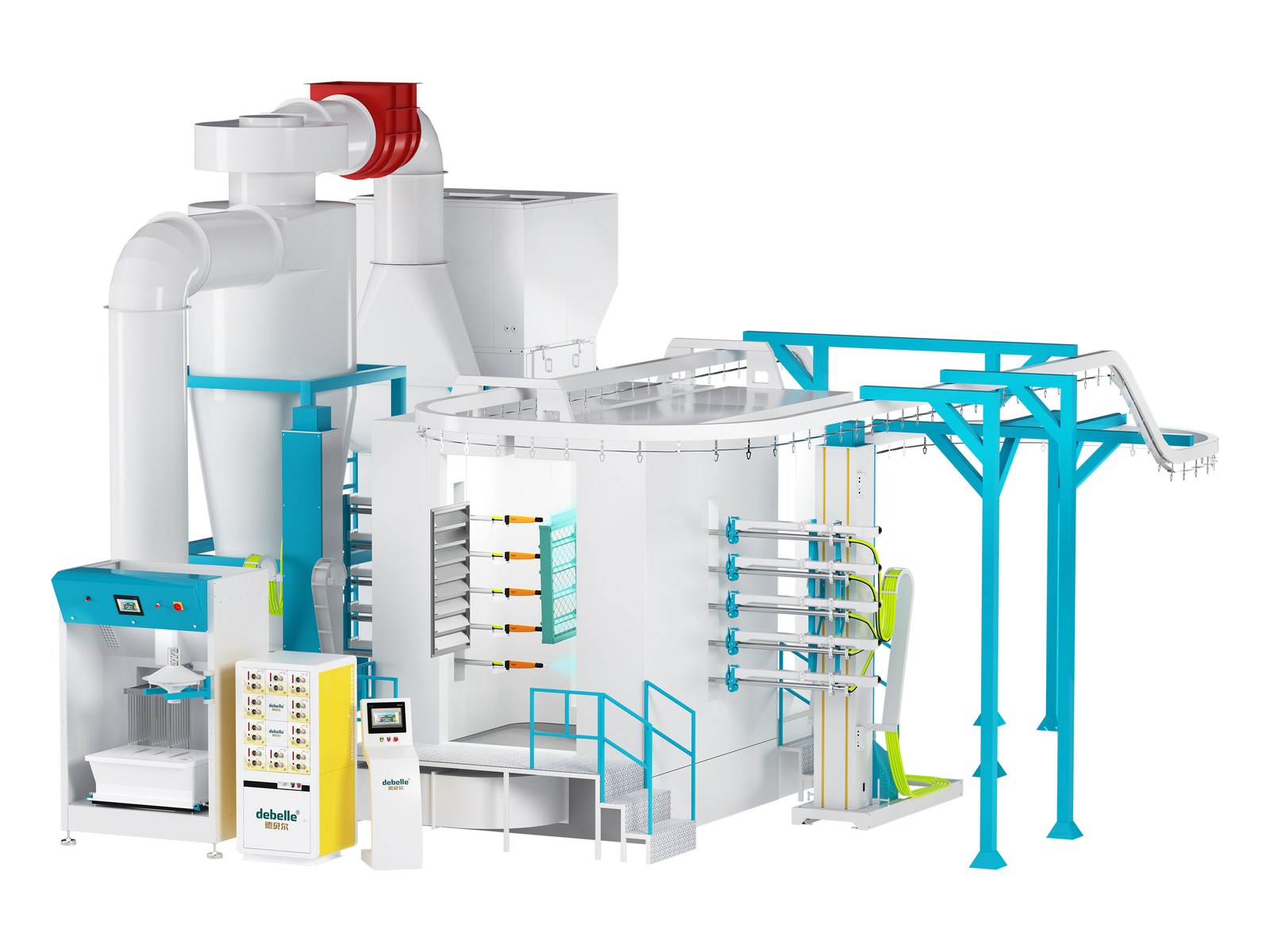
The same request for a powder coating equipment setup can land on three generations of configuration. One shop needs a gun and a hopper. Another needs a continuous conveyor line. The dividing line is neither budget nor the number of guns. It is takt: whether you spray batch by batch, or the parts never stop moving. Quantify the takt and the tier decides itself.
1. Work out the takt before the tier
Daily capacity is not a figure on a specification sheet. It is three numbers from your own shop, multiplied together:
Daily capacity ≈ hang density × line speed × effective spray time
Effective spray time is planned hours minus colour change, gun cleaning, waiting on cure, gun adjustment and breakdown stops. How to measure each one, and where estimates usually go wrong:
| Variable |
How to measure on site |
Where the estimate goes wrong |
| Hang density |
Count the parts per hanger, measure the hanger pitch, divide the two |
Counting sample parts hung one to a hook, ignoring interference at full load |
| Line speed |
Mark the chain, time it over ten metres |
Taking the VFD readout as real speed, ignoring slip and accumulation sections |
| Effective spray time |
Log the hours the spray section is actually emitting powder, and count starts and stops |
Using the whole shift, counting colour change, cure waiting and touch-up as output time |
The error usually sits in effective time. A continuous line looks like it never stops, yet the hours it actually emits powder are often well short of the shift. Run the calculation on measured time first, then compare with the theoretical figure on the specification sheet. The gap between the two is your spare capacity.
2. Where the three tiers part
Put the takt next to the part characteristics and the equipment settles into one of three tiers. The table describes form, not price band.
| Dimension |
Small single unit |
Mid-size batch line |
Industrial continuous line |
| Conveying |
No chain, or simple racks and trolleys |
Light overhead chain or floor track, starts and stops at will |
Continuous overhead conveyor, fixed takt |
| Spraying |
Handheld gun, one gun |
A few automatic guns with a reciprocator or fixed positions |
Several gun positions with reciprocators, parameters centralised in a control cabinet |
| Powder feed |
Hopper direct to gun, short powder path |
Single hopper or a small feed unit |
Powder feed centre, multiple guns or colours fed from one point |
| Recovery |
Simple filter, sometimes no recovery |
Filter recovery, local enclosure around the spray zone |
Cyclone plus filter, two stages, enclosed booth |
| Curing |
Oven, batch loading |
Short oven, batch or slow pass-through |
Continuous curing oven, temperature profile set by line speed |
| Typical fit |
Prototypes, odd single parts, small batches |
Small to medium batches, more colours |
One or few colours, high volume, long parts |
The line is not drawn by money. It is drawn by whether the line may stop. A batch line can halt at any moment to clean a gun, change colour or wait for the oven. Once a continuous line’s takt is fixed, every stop is costed by the minute.
3. Four signals that you should move up a tier
Signal one: can the part be sprayed by hand? Once unit weight and geometry go past what a person can carry a gun over steadily, film thickness stops being repeatable by hand. What you need is a fixed gun position and a reciprocator, not a better gun.
Signal two: how much of the day is spent waiting. If waiting on cure, on loading or on transfer takes longer than spraying itself, the constraint is conveying and curing. Adding guns will not move output.
Signal three: colour-change frequency. Many colours in small batches do not automatically call for a continuous line, because colour change and gun cleaning take most of the takt advantage away. Focus shifts to powder-path cleanliness: choose a machine with a one-button cleaning cycle that blows residual powder out of the pump, hose and gun in one pass instead of stripping the gun down for an air gun, and keep the powder hose short.
Signal four: can hang density go up? Small parts on a continuous line lose hanging positions to part geometry and spacing. A faster chain will not buy output that the hanging pattern cannot carry. Hang one rack for real and measure the pitch before the line goes in; it beats reading drawings.
If two or more signals hold, look one tier up. If only one holds, jigs and process changes usually solve it without touching the whole line.
4. When the tier changes, re-calibrate the process
Moving up a tier does not change what the gun can do. It changes the takt. Speed up the chain and the parameters you had dialled in are no longer right, which shows up on site as scattered bare metal or as banded light-and-dark striping. Both point at the chain speed no longer matching the spraying action.
| Parameter |
Common range |
What it follows |
| Powder output |
15–100 |
Part size, recess depth, hanging density, line speed |
| Atomising air |
10–50 |
Low for recessed parts, high for flat panels |
| Voltage |
30–100 kV |
Too high gives orange peel, too low gives poor deposition |
| Current |
15–80 μA |
Same trade-off as voltage |
| Air pressure |
≥0.6 MPa |
Never below this value, and never fluctuating |
| Gun distance |
200–300 mm |
Too close gives orange peel, too far gives poor deposition |
| Earth rod |
≥2 m deep |
Driven in near the booth, connections left bare |
This table holds on a small single unit and on a continuous line alike. Parameters follow the part and the takt, not the equipment tier. After a tier change or a chain-speed change, the first job is to re-calibrate on the same batch of parts rather than reusing the old parameter card. Machines such as the V12 automatic gun that store parameters per part are built for a continuous takt, while shops still working mainly by hand can follow the configuration logic of the E7 manual gun.
5. Troubleshooting: undersized and oversized both show up
| Symptom |
Likely cause |
How to confirm |
| Plenty of guns, daily output still flat |
Hang density is low and chain speed never came up |
Count hanging positions and pitch, then rerun the takt calculation |
| Most of the day spent waiting on cure |
Curing and spraying takt do not match |
Log parts in and out of the oven and compare with spray-section output, period by period |
| Bare spots appearing after the change |
Chain speed and parameters were never re-calibrated |
Work through the list: chain speed, powder output, voltage, pressure, powder build-up at the nozzle |
| Banded light-and-dark striping on the surface |
Chain speed and reciprocator do not match |
Adjust chain speed and reciprocator stroke, then compare on the same part |
| Many colours now slower on a continuous line |
Colour-change cleaning costs more than the takt gains |
Count daily colour changes and the cleaning time of each |
| Powder consumption high on small parts |
Hang density cannot rise, so booth and colour-change losses dominate |
Work out consumption per part, not per metre of chain |
Work in this order: identify which section the symptom comes from, then return to the takt formula to see which variable drifted. Most conclusions of “the equipment is not enough” end up back at hang density and effective spray time.
6. Self-check list
The point of choosing a tier is to make the takt match your parts and your order book, not to make the configuration sheet longer. Send us your part photos, unit dimensions and weight, target daily capacity and colour count and we will work through this method with you. Where it is close, send a sample part first and let the measured takt decide the tier. Contact us