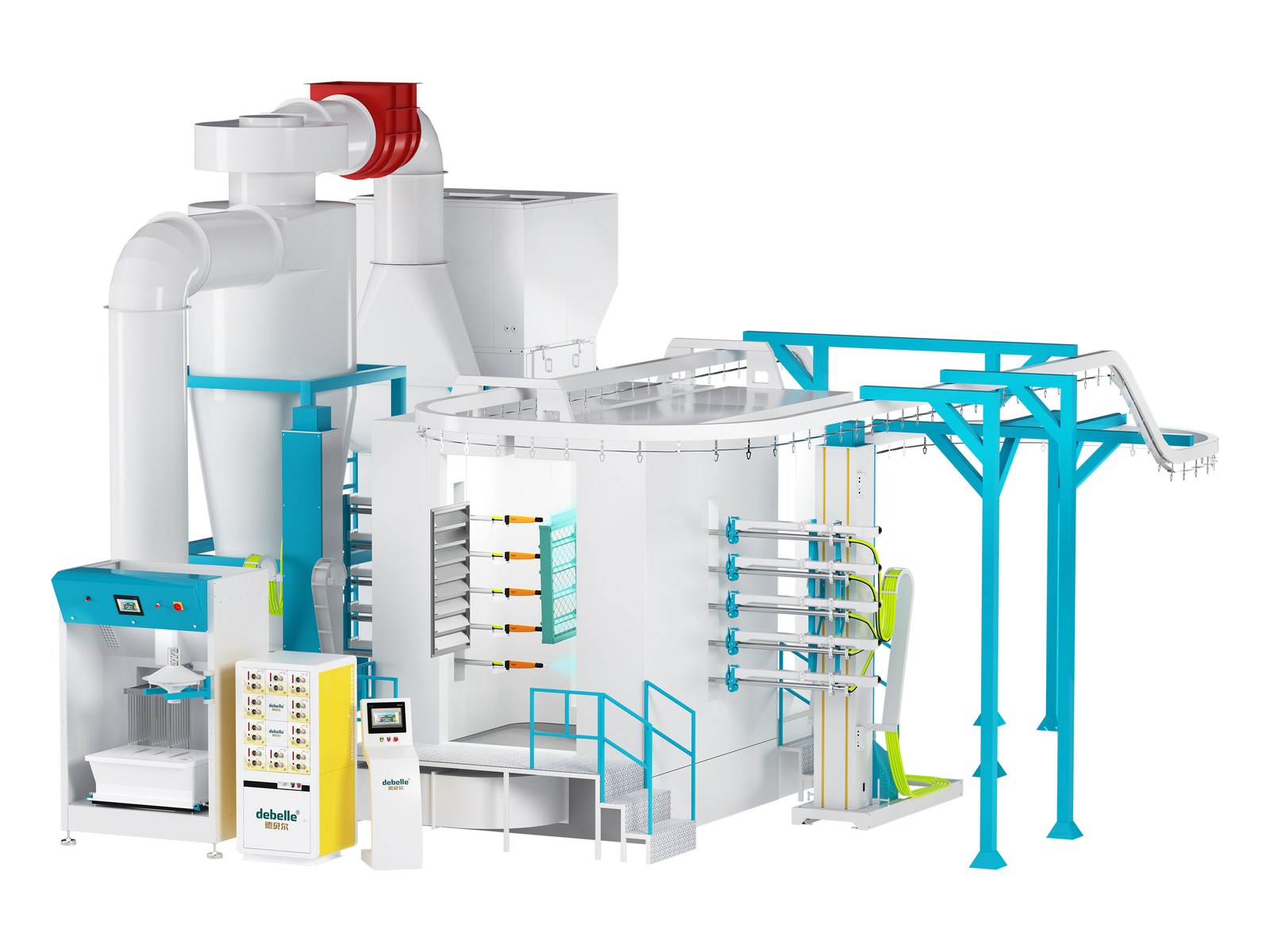
Choosing a powder coating gun for aluminum profiles is less about which gun is good and more about what your line and your parts actually need. Two lines running the same extrusion can differ by an order of magnitude in gun count, powder hose length and air supply. Two profiles from the same line can call for different voltage and atomizing settings. Settle the line type and the part shape first, and the gun and its settings follow.
1. Start with the line: horizontal and vertical lines select differently
On a horizontal line the profiles lie flat or hang at a shallow angle. There are few gun positions, usually a few automatic guns plus manual touch-up, and the point is reachability: grooves and section corners that the automatic guns miss have to be covered by hand. Air demand across the line is modest, so a 2-inch main pipe to the controller is enough and a 30 kW compressor class fits.
On a vertical line the profiles hang vertically, one long piece each, with a row of automatic guns and a reciprocator running up and down. Here the point is consistency: a dozen guns have to track chain speed together, and repeatability across guns matters more than the peak performance of any single one. Air supply and piping are sized for the whole row, so a 4-inch main pipe (DN100) and at least a 3-inch hose up to the controller are typical; two powder booths call for a 90 kW compressor class and three booths for 110 kW.
| Item |
Horizontal line |
Vertical line |
| Part orientation |
Flat or angled |
Vertical, long single pieces |
| Gun positions |
Few automatic guns + manual touch-up |
Full row of automatic guns + reciprocator |
| Main pipe |
2.5-inch (DN65) / 2-inch to controller |
4-inch (DN100) / at least 3-inch hose |
| Compressor reference |
30 kW |
90 kW for two booths / 110 kW for three |
| Selection focus |
Touch-up flexibility, fast gun changes |
Multi-gun consistency, hose wear and long powder feed |
Automatic powder hoses are also chosen by line: on a vertical line the hose run is longer, so wear resistance drives long-term stability, and lines such as aluminum that want even atomization typically run the 11×16 mm class.
For the range of aluminum line setups and typical configurations, see the aluminum profile coating page.
The second step is confirming the part shape and the powder type. This step sets voltage, current and atomization, not the model number — the same gun will leave a deep channel bare if the settings are wrong.
The four situations you meet on aluminum profiles sit in these bands:
| Part / powder type |
Voltage |
Current |
Atomizing tendency |
Note |
| Flat sections (large area, no deep channel) |
70–90 kV |
40–60 µA |
Higher, powder spreads out |
Too little atomization gives banding and zebra striping |
| Grooved parts (deep channel, complex section) |
60–80 kV |
30–50 µA |
Lower, powder stays tight and penetrates |
Air carries the powder into the cavity |
| Metallic powder |
60–80 kV |
30–50 µA |
Moderate |
Excess voltage causes back-ionization and raises the risk of color deviation |
| Recoat / second-pass parts |
20–40 kV |
10–30 µA |
Moderate |
Keep voltage low so the second coat does not build up and orange-peel |
Do not reverse the atomizing direction: less atomizing air means the powder leaves tighter and denser, which suits grooved parts; more atomizing air means the powder spreads softly, which suits flat sections. Powder output follows blank size, groove depth, hanging density and chain speed, so heavy-wall and deep-channel work needs more of it.
Gun distance is where site settings drift most: keep 200–300 mm between the profile and the nozzle. Closer tends to orange-peel, further tends to under-coat. Long profiles on a vertical line also vary in distance top to bottom, so the reciprocator stop positions have to be set deliberately.
Settings are not meant to be memorized, they can be stored. Models with data packages let you save complete parameter sets for flat powder, textured powder and metallic powder and recall them when the powder changes, so a new operator does not have to work by feel. See the V12 product page for how that adjustment works.
3. Match the gun to the job: three job types, three levels of requirement
You do not need to memorize the catalogue. Sorting by job is enough.
| Job |
Traits |
Suggested direction |
What to check on site |
| Mostly flat parts, normal requirement |
Large simple sections, only film thickness has to hold |
Entry-class manual gun (E7, the 80 kV class) |
Enough voltage steps, steady powder output |
| Metallic powder / grooved parts / recoat |
One or more of the three classic difficulties |
100 kV class manual or automatic gun (TOP-960, T30L) |
Voltage adjustment range, fine current control |
| Full row on a vertical line |
Many guns linked, linked to chain speed |
Automatic guns with a control cabinet (V12 class, with part memory and linked control) |
Whether all guns can be adjusted as one |
One counter-intuitive point: not every aluminum line needs the top configuration. For flat parts with a normal requirement, an entry-class manual gun with well-set parameters is enough. It is deep channels, metallic powder and recoat work that need the extra adjustment range of a 100 kV class gun. Report the section drawing, the powder type and the daily output first, and then talk about models.
4. Three problems specific to aluminum profiles
Once the gun is chosen, the real site problems cluster in three places.
Bare grooves. Deep cavities and complex sections shield the field (the Faraday effect), so powder struggles to reach inside. Besides parameter adjustment, check two things that are not about the gun: whether the hanger hooks have built up an insulating powder layer — a non-conductive hook produces regular bare patches, and bare spots that follow the hanging points point to exactly this — and whether the profiles carry aluminum burrs or oil, which have to be cleaned before loading.
Metallic powder color deviation. Metallic powder is sensitive to charging stability, and excess voltage actually causes back-ionization. Work in the middle of the band and keep one recipe for the whole batch instead of changing it shift by shift.
Orange peel on recoated parts. A second pass builds film thickness quickly. Use low voltage (the 20–40 kV band), control the film thickness and do not push the gun closer than 200 mm. When orange peel appears only at the top and bottom ends of the part, also check the reciprocator stop positions and whether transition bars are placed at the ends.
5. Before choosing a gun, confirm these four site conditions
Correct parameters and the right model still will not coat well if the site conditions are off. Confirm these four before signing the configuration sheet:
| Item |
Requirement |
Symptom when it is off |
| Power |
220 V, allow 50 W per gun |
Voltage sags when several guns run at once |
| Air pressure |
Not below 0.6 MPa (6 kg), moisture below 2 percent, piped separately from the booth air |
Powder output swings, coating is unstable |
| Air consumption |
About 0.2 m³/min per gun |
Pressure drops when several guns run at once |
| Grounding |
Earth rod at least 2 m deep, driven near the booth, routed separately from power lines |
Current reading fluctuates, powder will not adhere |
Grounding is the item most often skipped and most often the root cause. On vertical lines another common approach is to bond the earth to the I-beam frame of the line so the conductive path stays continuous along its whole length; the exact method depends on the site structure.
Troubleshooting path
These three symptoms come up most often on aluminum lines. Work through them in this order instead of replacing the gun first.
Bare patches that follow the hanging points, in a regular pattern. Most likely a non-conductive hanger. Take the hook off and look at the powder build-up, then clean it back to bare conductive metal before loading again.
The current reading jumps and will not settle. Check the ground first: whether the depth is sufficient, whether the cable runs parallel to power lines, whether the joints are tight. If the reading still jumps after the ground is routed separately, check the position of the earth rod relative to the booth.
Powder output swings and the coating is unstable. Watch the pressure gauge while spraying — if it falls below 0.6 MPa or oscillates, the problem is upstream in the air supply: compressor capacity, receiver tank volume, line leakage, one at a time. Stable air pressure is the precondition for stable powder output, and no gun adjustment can substitute for it.
Site checklist
Send us the section drawing, the powder types you run and your daily output, and we will work through the selection with this same logic. If you have sample parts, spray them first and set the voltage and atomizing recipe from measured results. When you are ready to plan, you can contact us.