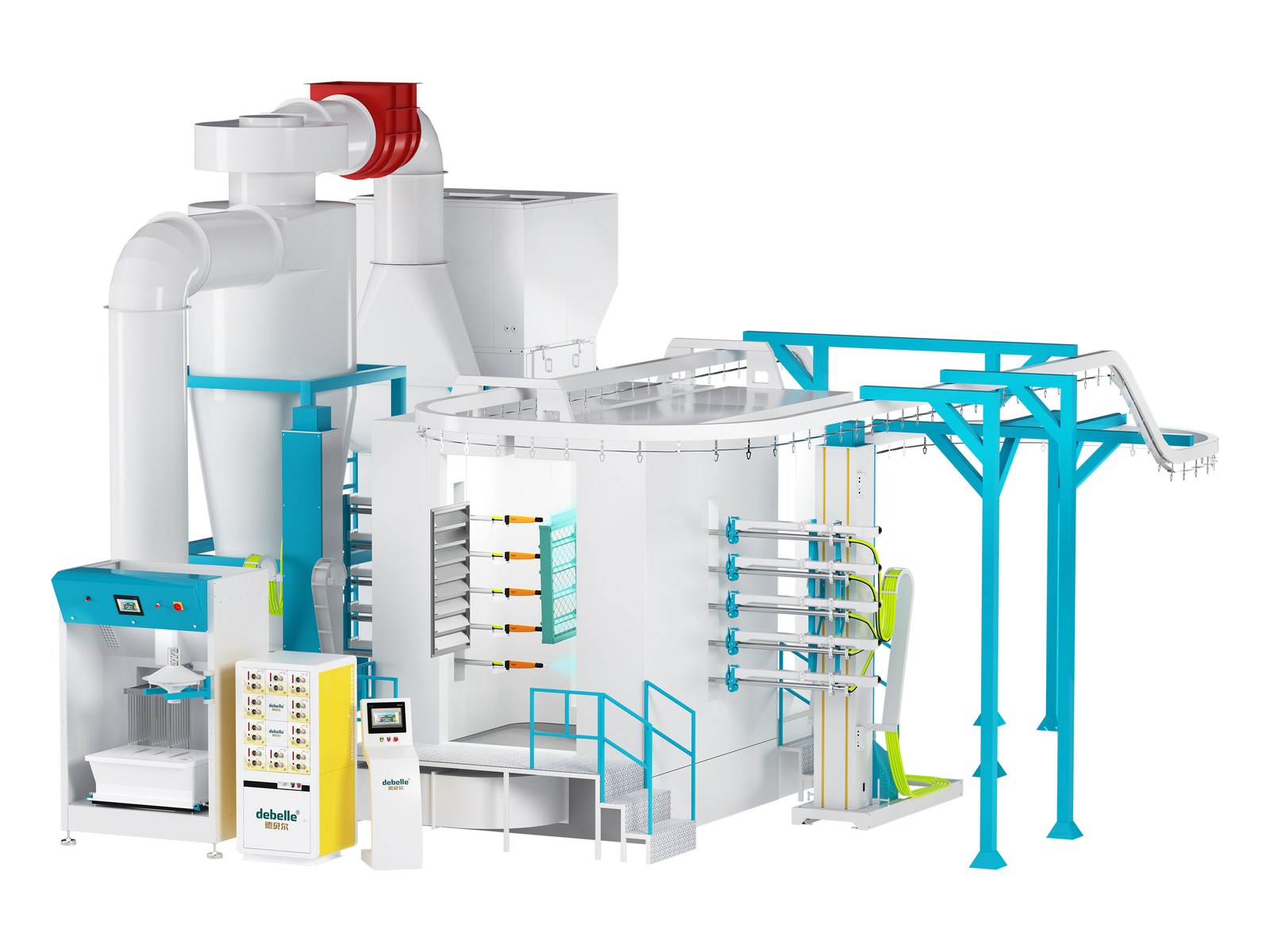
Manual or automatic should not be decided by budget. It should be decided by three questions: how big is a typical batch, how often do you change color, and can you keep skilled spray operators. Picking the wrong direction makes the cheaper option expensive - a manual gun that cannot hold capacity, or an automatic line that starves for workpieces, are both common forms of waste. This article answers one question only: when should a manual line switch to automatic.
What each type of gun is actually for
A manual electrostatic powder coating gun is held and moved by the operator, which suits mixed parts, small batches, many colors, and frequent sample spraying. An automatic gun is fixed on a bracket or reciprocator and runs continuous cycles at preset voltage and powder output, which suits stable part shapes and large batches. The electrostatic principle is the same; the difference is who controls the pace - a person, or a program.
| Aspect |
Manual gun |
Automatic gun |
| Operation |
Operator-held, pace follows the person |
Fixed bracket or reciprocator, continuous cycle |
| Best fit |
Small batches, many variants |
Large runs of similar parts |
| Color change |
Swap hopper and purge |
Fluidizing powder center changes color more smoothly, at higher investment |
| Consistency |
Varies with operator feel |
Program-fixed, stable between batches |
| Labor |
Depends on skilled sprayers |
One person can watch several guns |
| Spare parts |
Monthly checks are enough |
Runs continuously, wears faster, check per shift |
| Upfront cost |
Low |
Gun, reciprocator, controls, booth package |
It helps to look at representative models first, for example the V12 automatic powder coating gun and the E7 manual powder coating gun, then judge against your own part shapes.
Capacity: the bottleneck is takt time, not gun speed
On a manual line, the capacity ceiling is set by the number and skill of sprayers: one sprayer coats a fairly fixed number of parts per hour, so adding capacity means adding people. On an automatic line, capacity is set by conveyor speed and gun count, but only if loading, pretreatment, and curing keep up - after automation, the bottleneck usually moves somewhere else. A faster gun alone does not solve it.
A test you can run on site: record shift output for three days in a row. If day-to-day variation exceeds 20 percent, fix loading and labor fluctuation first; automation comes later. Stable output with a full order book is where automatic guns belong.
Single-gun powder output is a useful reference: a built-in automatic gun can reach around 420 g/min (per the product parameter sheet), the same order of magnitude as a manual gun. The gain from automation is not more powder per gun - it is a stable takt, batch-to-batch consistency, and output that no longer swings with who is holding the gun.
Cost: four items beyond the gun price
- Upfront investment: an automatic line is never just the gun. Reciprocator, control system, booth, and recovery all count. A manual line is basically gun plus controller.
- Spare-part consumption: an automatic line runs longer per day, so parts like the internal powder tube wear faster than on a manual line. Schedule checks per shift, not per month - this difference shows up repeatedly in after-sales cases.
- Line readiness: an automatic gun has prerequisites. Booth, recovery, compressed air, and power must be in place first; the bracket needs a rigid steel tube - a soft bracket lets the gun vibrate and film thickness scatters.
- Labor structure: a manual line saves on equipment but pays in skilled wages and turnover. An automatic line fixes parameters into preset programs (built-in programs for flat, texture, and metallic powders), so a new operator can follow the program and dependence on veteran feel drops.
Add all four items up before judging payback, instead of comparing gun prices only. List each item at site-quoted values rather than estimates.
When to switch: check against this table
| Signal |
Stay manual |
Consider automatic |
| Shift output |
Varies widely, parts change daily |
Stable, similar parts in sequence |
| Order pattern |
Mostly samples, scattered batches |
Steady schedule, regular overtime |
| Colors |
Many colors, frequent changes |
Few colors or batched changes |
| Operators |
Available and retained |
Hard to hire or high turnover |
| Line readiness |
No fixed booth |
Booth, recovery, and air supply ready |
Three or more hits in the right column justify a move; one or two mean you should improve locally first, not rebuild the line.
How to transition without starting over
Check controller compatibility first. Many gun models come in a manual and an automatic version sharing the same control platform, so the upgrade adds gun bodies and a reciprocator while controls and the high-voltage module stay. Ask about this when buying a manual gun - it leaves the door open.
Add one gun, then expand. Put one or two automatic guns on the highest-volume fixed-part station, keep a manual gun nearby for dead corners and changeovers, and expand to a full line only after film thickness and takt are proven stable.
Check three things at installation: bracket rigidity (steel tube), workpiece grounding, and that the fault-code self-check works. An automatic gun with condition self-checking lets maintenance staff follow the code instead of guessing segment by segment.
Checklist
Send us photos, dimensions, daily output, and your color list, and we will work through this logic with you - add manual capacity first, or go automatic directly. Where needed, we start with a sample spray test and let measured data decide the configuration. To discuss a specific case, feel free to contact us.