Typical Working Conditions in This Industry
Pipes, guardrails, fencing, wire mesh and grating share these characteristics:
- Large dimensions and heavy individual pieces; hanger load capacity and grounding are basic issues
- Long tube parts; constant manual gun travel is difficult
- Fine wire diameter in mesh parts, making electrostatic adhesion difficult (this is a process challenge, not an equipment problem)
- Outdoor use, with high weather resistance requirements
The Constant Speed Problem on Long Tube Parts
On long parts such as tubes, crossbars and posts, uneven gun travel speed directly causes film thickness differences from end to end.
Available approaches:
| Approach |
Description |
Suitable for |
| Two operators in sections |
Overlapping coating at the handover; requires good coordination |
Small batches, irregular parts |
| Fixed guns + moving workpiece |
Let the workpiece move relative to the gun |
Large batches, regular parts |
| Automatic reciprocating |
Gun travel locked into a program |
Large batches, stable |
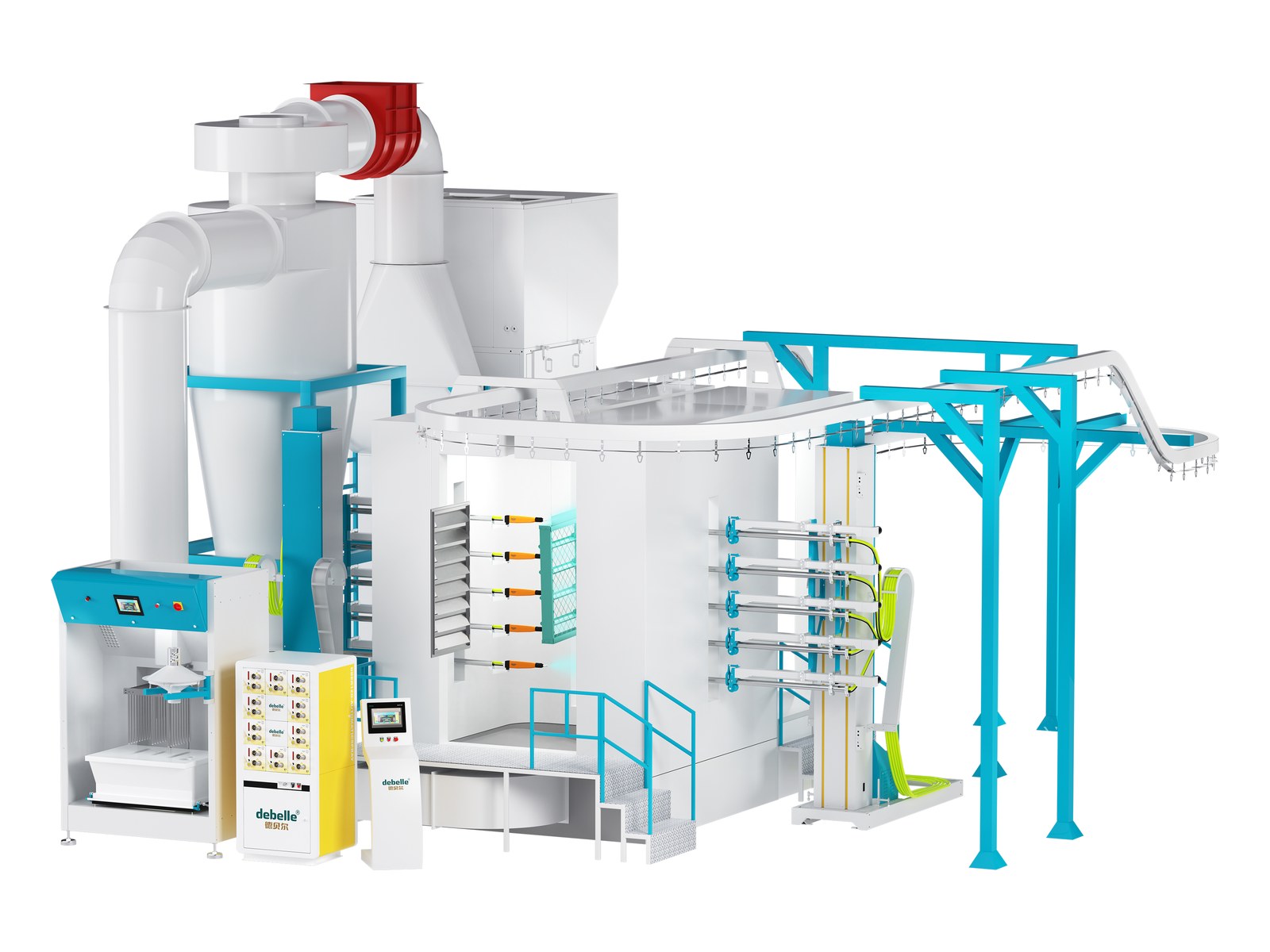
Key insight: making the workpiece move makes it easier to hold a constant speed than making the gun move.
If output is sufficient, hanging the workpiece on a conveyor with fixed guns gives noticeably better consistency.
Wire Mesh and Grating: A Process Challenge
For fine-wire mesh and grating, electrostatic coating adhesion is inherently limited:
- Fine wire diameter → the electrostatic field cannot establish an effective potential difference on the thin wire
- Many mesh openings → powder easily passes through the mesh and hits the reverse side, causing waste
- Shadowing effect → wires directly facing the gun get more powder, wires behind get less
Approaches:
- Reduce conveyor speed to increase the amount of powder in a single pass
- Opposed guns on both sides to reduce the shadowing effect
- Tribo guns — for long slender parts and mesh, triboelectric charging is sometimes more effective than high-voltage electrostatic
- For mesh-type workpieces, consider dip coating or a fluidized bed process as an alternative
If a supplier promises that “electrostatic coating can perfectly solve powder adhesion on mesh”, verify cautiously,
preferably by sending samples for a trial spray first to see the result.
Outdoor Weather Resistance: Don’t Choose the Wrong Powder Type
Outdoor guardrails and fencing are exposed to sun and rain long term, and the wrong powder choice leads to early chalking and loss of gloss.
- Epoxy powder: good chemical resistance, but poor weather resistance; chalks easily under UV exposure — not suitable for outdoor use
- Polyester powder: good weather resistance; the mainstream choice for outdoor parts
- Epoxy-polyester hybrid: the general choice for indoor parts, with good cost performance
Do not use pure epoxy powder for outdoor parts — this is the most common selection error.
Hangers and Grounding
Design points for hangers carrying large heavy parts:
- Ample load capacity margin to prevent falling off during coating
- Contact points must expose bare metal, and the oxide layer must be treated periodically
- When hanging on multiple hooks, make sure every hook conducts and do not rely on a single point
Grounding resistance of ≤1Ω is recommended. Poor grounding on large parts causes both low transfer efficiency and a safety hazard.
What We Need From You
- Workpiece type, maximum dimensions and weight per piece
- Daily output and current hanging method
- Whether for outdoor or indoor use (this determines the powder type)
- Whether mesh-type workpieces are involved